
The EU’s Tech Sovereignty Package: what it means for business
An assessment of the European Commission’s long-anticipated technological sovereignty package and its implications for businesses operating in, or seeking access to, the EU market.
Overview
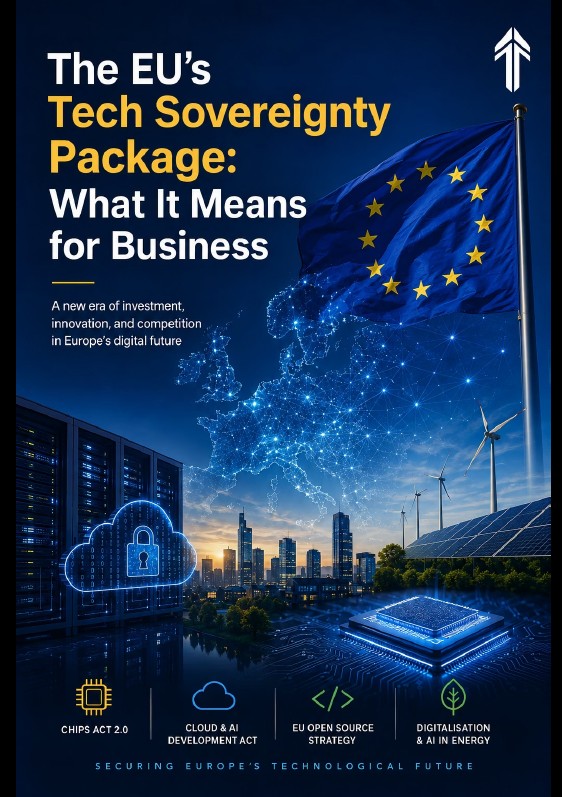
On 3 June 2026, the European Commission released its long-anticipated technological sovereignty package – a four-part initiative comprising the Chips Act 2.0, the Cloud and AI Development Act (CADA), an EU Open Source Strategy, and a Strategic Roadmap for Digitalisation and AI in Energy. For companies operating in or seeking access to the European market, this represents a structural shift in how the EU intends to shape procurement, investment and competitive conditions across the digital economy – not merely incremental regulatory development.
Europe has historically pursued a regulatory model of sovereignty – GDPR, the DSA, the DMA, the AI Act – excelling at setting standards and binding foreign companies to its values. The Commission now recognises the structural gap cannot be closed by regulation alone: more than 80% of Europe’s digital products, services and infrastructure rely on non-EU providers, three US hyperscalers control over 70% of the EU cloud market, and Europe consumes nearly 20% of global semiconductor output while producing only around 9%. The package is designed to address those investment and industrial failures directly.
What the package contains.
The Commission has moved beyond standard-setting toward industrial intervention. Four instruments define the shift – and the competitive conditions businesses will operate under.
Chips Act 2.0
A renewed push to rebuild EU semiconductor capacity against a ~9% share of global output versus nearly 20% of consumption.
Cloud and AI Development Act
Measures to narrow dependence on the three US hyperscalers that control more than 70% of the EU cloud market.
EU Open Source Strategy
Open-source software positioned as a lever for digital autonomy, interoperability and reduced vendor lock-in.
Digitalisation & AI in Energy
A strategic roadmap embedding AI and digital infrastructure in the energy transition and critical systems.



Brief your next decision with the full picture.
Initial conversations are confidential and obligation-free.