
Off-World Compute: Serious Solution or Costly Distraction?
The engineering reality and economic fragility of orbital data centres. The most credible near-term market is specialised orbital edge, storage and sovereign compute – true hyperscale AI training in orbit remains a high-stakes bet on several thresholds being crossed at once.
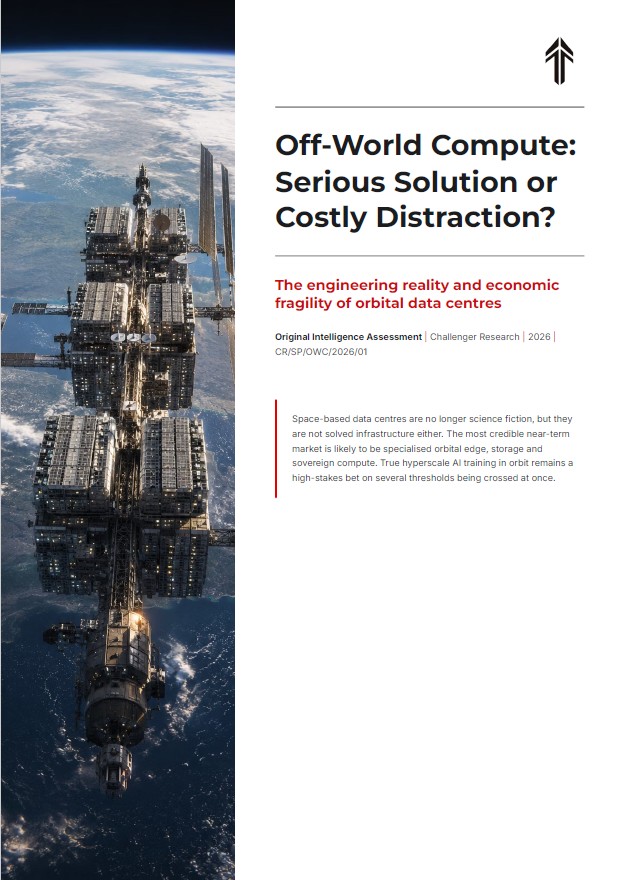
Overview
The digital economy is beginning to collide with terrestrial infrastructure limits. AI workloads are intensifying demand for power, land, cooling and grid connections at precisely the moment many primary data-centre markets face long interconnection queues, permitting friction, water constraints and local opposition. That pressure is what has moved orbital compute from a speculative idea to a serious commercial and strategic proposition.
The attraction is intuitive – space offers near-continuous solar energy, physical separation from terrestrial siting bottlenecks, and the possibility of a new layer of digital capacity beyond Earth. But orbit does not remove infrastructure constraints; it changes which constraints dominate. This assessment separates the credible near-term market from the high-stakes bet of true hyperscale AI training in orbit.
Where the case is strongest – and where it isn’t.
Orbit changes which constraints dominate rather than removing them. Three advantages explain the momentum; one question decides whether it scales.
Near-continuous solar power
Orbital platforms can harvest solar energy without the day/night and weather interruptions that constrain terrestrial renewable supply.
No terrestrial siting friction
Orbit bypasses the permitting delays, land scarcity, water constraints and local opposition slowing data-centre expansion on Earth.
A new capacity layer
Space offers the possibility of an entirely new tier of digital infrastructure, decoupled from the geographic and political limits of terrestrial grids.
The real question
Not whether computing can happen in space – we know it can – but whether it can become economically viable, operationally resilient and strategically useful at meaningful scale.

Brief your next decision with the full picture.
Initial conversations are confidential and obligation-free.