
Ukraine's Post-war Reconstruction: strategic risk, environmental exposure & societal impact
A multi-dimensional assessment of reconstruction risk in post-war Ukraine: environmental contamination, societal trauma, governance fragmentation, and the capital flows that will determine whether reconstruction succeeds or stalls.
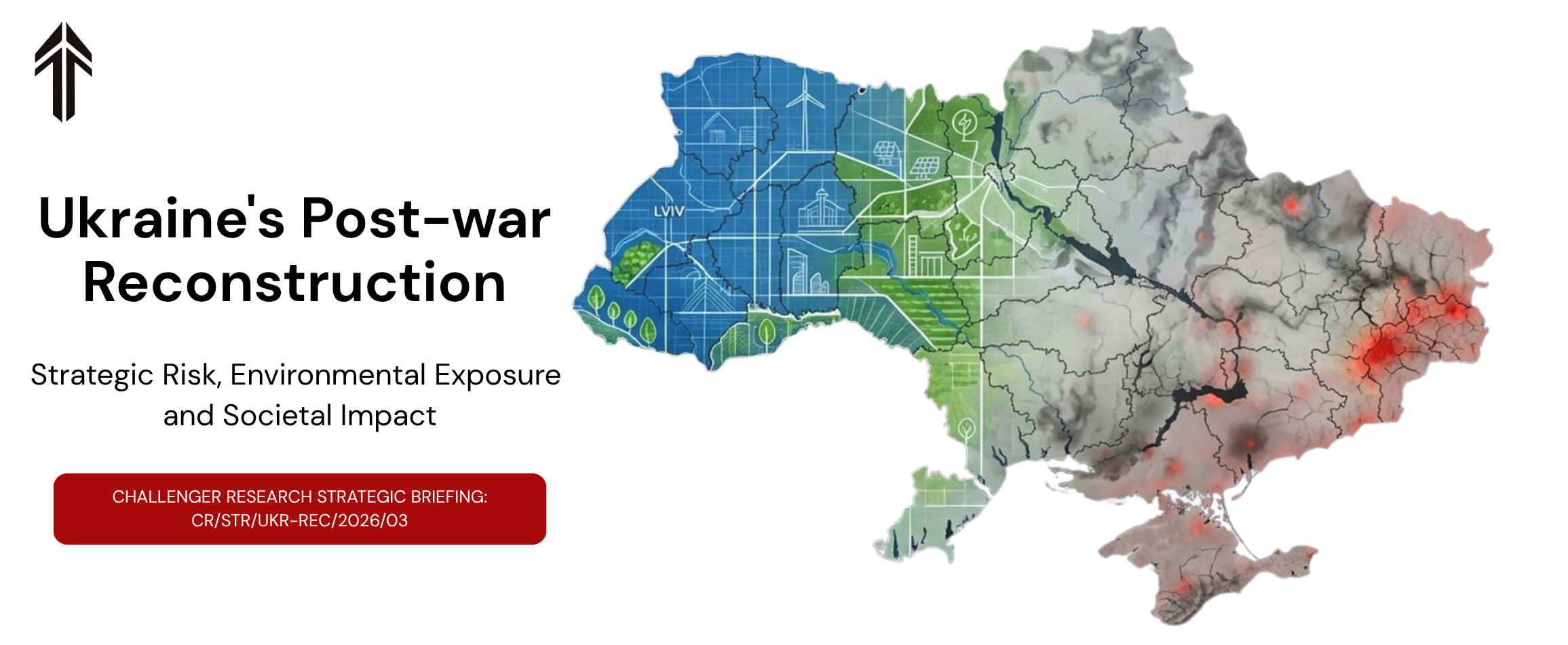
Overview
The reconstruction of Ukraine will be the largest post-conflict rebuilding effort since the Second World War. Most of the early planning has focused on the headline capital number; what gets less attention is the substrate it has to be built on: a country with extensive environmental contamination, generational societal trauma, fragmented governance, and a capital-attraction problem that the war has only deepened.
This briefing maps the reconstruction risk across four dimensions, identifies the specific oblasts where the substrate question is most acute, and traces the policy and capital decisions over the next 18 months that will determine whether reconstruction succeeds, stalls, or quietly degrades into a multi-decade project.
The substrate reconstruction sits on.
Headline capital is only part of the picture. Each of these dimensions has the potential to stall, or unmake, the broader rebuild.
Contamination & remediation
Soil and water contamination from munitions, fuel, and industrial damage; the remediation cost curve and where it lands.
Trauma & demographic exposure
Demographic shifts, displacement, mental-health load, and the workforce-availability problem that constrains reconstruction speed.
Institutional integrity at oblast level
Fragmentation between central, regional, and municipal authorities, and the integrity questions that determine where capital can flow.
Attraction, absorption, accountability
The structural gap between announced capital, absorbable capital, and accountable capital, and the policy instruments meant to close it.



Brief your next decision with the full picture.
Initial conversations are confidential and obligation-free. We respond to every enquiry within one business day.